
Swabhav is your Swasthiti—act accordingly. But how?
By Vivek Sharma
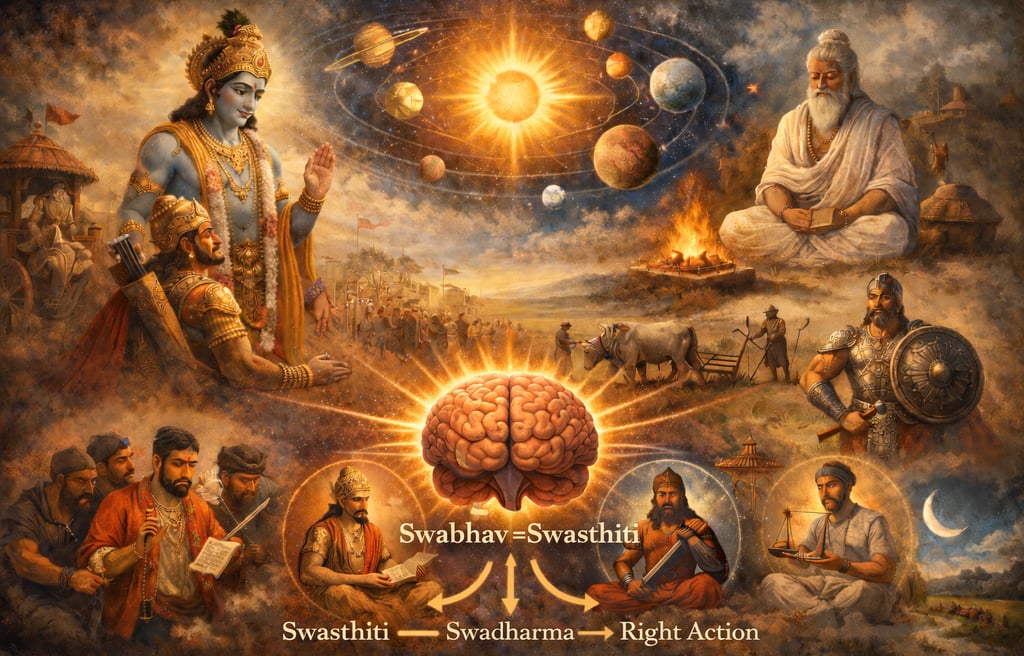
We come across the term स्वभाव a lot while going through Hindu Sanskrit texts. It is considered to be an equivalent of one’s nature. But, well it doesn’t really fully explain the profound dimension of the word, without understanding which we can hardly gather its true import. Let us understand it in the light of the concluding part of shloka 47 in discourse 18 of the Bhagwad Gita. स्वभावनियतं कर्म कुर्वन्नाप्नोति किल्बिषम्॥ It means doing action as per ‘one’s nature’ doesn’t make one accrue negativity. Now the question is how does one know what one’s nature is? In fact, the term hints at something knowable, doable and actionable. Something concrete to work on. स्व does mean one’s . But भावः [भू-भावे घञ्] has a deeper dimension. It hints at one’s state of being or to simplify it further, it means one’s स्थिति, position at a particular time and place. We can, therefore, re-term स्वभाव as स्वस्थिति — one’s state of being in a situation. Now this position does indicate the outer and the inner situations both. The outer situation is nothing but a gross, materialised projection of the inner situation.
Its role is to confirm, influence and keep one in a particular circle of causes and effects which gives one a particular direction ( दिशा) to evolve and get out. Basically, स्वस्थिति connotes your positioning in a given situation warranting action in line with your inner स्थिति . Both outer and inner स्थिति must tally and must be in the same line for a particular action to be undertaken. Cosmic Situation and Karma In the cosmic arrangement, the sun is positioned at the centre of the solar system and all the planets are arranged around it at different distances, experience different pulls from it. The sun’s positioning in the set-up, its burning brilliance and energy emissions bathe all the planets differently and spread far and wide thereafter. The sun is located at the centre of the solar system is its स्थिति. And its role to energise all the planets, holding them in different orbits and related things make its स्वभाव or स्वस्थिति. Its situation within and without make it burn bright and send off energising waves all around. This particular karma by the sun doesn’t make it accrue any negatives even if it kills many in the line of action. The same way the moon has a particular situation in the solar system. It absorbs solar energy, converts it into a nourishing energy which sustains beings on the earth.
In Discourse 15, Shri Krishna says पृष्णामि औषधीः सर्वाः सोमो भूत्वा रसात्मकम् — I nourish all the vegetation and brains by becoming moon energy frequency ( रस् also means a deep sound frequency which converts into a nourishing liquid energy in vegetation and brains through a subtle series of cause and effect ). Waxing and waning of the moon define its role of modulating the solar energy emissions to the earth. Now this particular स्थिति of the moon mandates certain direction (दिशा) to do its job that direction born out of its स्थिति is its स्वभाव or स्वस्थिति. Working out its job in that direction by its स्थिति doesn’t get it any negatives. Now what the sun, the moon and all the planets are doing is स्वभावनियतं कर्म — job decided by their particular placements in the solar system. Krishna says working as per that स्वभाव doesn’t result in negativities— कुर्वन्नाप्नोति किल्बिषम्. Understand Swasthiti Now all the movable and immovable created ones live in separate groups having similar स्थिति ।
Now all of them have their individual placement too that defines their individual स्थिति . Individuals of the same स्थिति also have a particular differentiating स्थिति and hence they have different स्वभाव . That is why even the siblings born in the same group have their individual स्थितिs and स्वभावs and hence different directions of actions. Krishna sums up these स्थिति-borne स्वभावाs in human beings into four categories — brahman, kshatriya, vaishya and shudra . The intellectual types, irrespective of where they are born are brahmans, and their स्वाभाविक कर्म is intellectual, spiritual and related pursuits. Undertaking the स्वाभाविक कर्म will not fetch them any negativities. The warrior types, irrespective of where they are born, and their स्वाभाविक कर्म is defending the nation, protecting the weak, fighting against injustice. When a soldier kills an enemy to defend the nation, he doesn’t get any negative consequences, because it is his स्वाभाविक कर्म . Now an individual born in the group of Shudra may have a स्थिति which gives him the direction to do intellectual pursuits and evolve spiritually. In that case too, the person shall have a स्वाभाविक कर्म of a brahman and hence he won’t attract any negativities while doing actions accordingly. Now the question arises that a person born to a Brahman family is by way of primary स्थिति a Brahman and hence his स्वाभाविक कर्म shall be intellectual pursuits. But, this स्थिति is his locational स्थिति, which is not complete if it doesn’t go with his situational position.
His state of being in a situation will decide whether he is a warrior type, intellectual type or a serving type. Arjuna by way of his location and situation is a warring type. But he under the impact of intellectual propensity tries to act like a brahaman in the battlefield. His situation in the battle warrants him to fight and win or die ! Krishna wants Arjuna to recognise his स्वस्थिति and act accordingly and that takes Him detail the whole Gita. स्वस्थिति is what is important for the man in a situation. Imagine a pandit is gheraoed by a bunch of toughs. Now his स्वस्थिति warrants him to use whatever is at his disposal to get out of their clutches. It may be his shastra gyan, neeti …but one thing is clear. His स्वस्थिति is like that of an Arjuna in the battlefield. Therefore, he should be prepared to fight his way out either by neeti, cleverness or physical prowess. Basically, the moment we understand स्वस्थिति, we understand स्वधर्म—what is to be done. Krishna advises Arjuna : श्रेयान् स्वधर्मो विगुण: परधर्मात्स्व नुष्ठितात्। स्वधर्मे निधनं श्रेय: परधर्मो भयावह:॥३/३५॥‘Better is one’s स्वस्थिति born right action, though seemingly imperfect, than the well performed one of a person of different स्वस्थिति ; better is death during action in one’s own situation; following action of a person of different स्वस्थिति is fraught with fear.’
Swabhav is your Swasthiti—act accordingly. But how? By Vivek Sharma
SANSKRITI SCIENCE
Vivek Sharma
2/23/20264 min read