
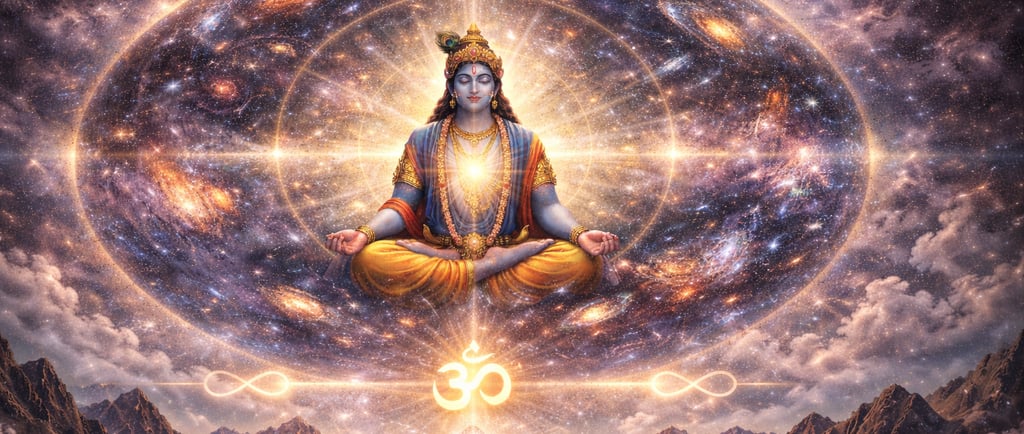
This whole universe is like an ever expanding sphere with a definite centre present everywhere and an infinite circumference —means it doesn’t end and when it doesn’t end it has no beginning and when it has neither, it simply exists at two points at the same time!
Well, that means the centre and the circumference may appear as two spaced out points . But they aren’t different as in the case of the universe which the rishis call brahmaand = the Principle Egg from which everything has come out and in It it all stays. It exists there in two imaginary points at the same time . So whenever you point at a circumference, you are pointing at the centre the same time in this case.
So, logicians would say geometry doesn’t and cannot define this image ever where the centre and the circumference have no difference at all. Yes, that is defining a continuity without beginning and end. Indian rishis call this Existence Niraakar — which can’t be defined as one definite shape but whenever there is a difference between two points within it, a form is born. That is what you witness in His 11th discourse in the form of His virat roop, which is hard to behold, but has many shapes and forms dissolving in it and coming into existence again.
There is only one thing which geometrically defines this continuity and that is a dot. You make a smallest possible dot and you would not be able to find a difference between its circumference and the centre. Now make that invisible. What exists that is the centre as circumference!
Actually the expansion that we see is nothing but the result of our brain’s habitual capacity to see two points one static (the centre) and the other ( spaced out). The entire existence in reality, with all the properties of an expanding sphere, shapes, sizes and brilliance, can only be defined by an invisible dot.
That is what Krishna reveals during His 12th discourse by using a set of words in a specific order . He literally defines the universe of which we all are constituents and in which we all bodily exist, stay and dissolve .
ये त्वक्षरमनिर्देश्यमव्यक्तं पर्युपासते ।
सर्वत्रगमचिन्त्यं च कूटस्थमचलं ध्रुवम् ।।१२/३।।
सन्नियम्येन्द्रियग्रामं सर्वत्र समबुद्धयः ।
ते प्राप्नुवन्ति मामेव सर्वभूतहिते रताः ।।१२/४।।
‘But, those who worship (reach) the Imperishable, the Indefinable, the Unmanifested, the Omnipresent, the Unthinkable, the Unchangeable, the Immovable, the Eternal.’‘Having subdued all the senses, even-minded everywhere, engaged in the welfare of all beings—verily, they reach Me only.’
Now analyse the words He has used in these shlokas and How He equates reaching this as reaching Him. But the only condition is समबुद्धि — where the perception sees no difference in this and that ! He even says those who have attained समबुद्धि are alone सर्वभूतहिते रताः— engaged in everybody’s welfare or good. The whole world is perceptionally seeing differences or spaced out points and acting out accordingly — the result is conflicting dualities — good-bad, positive-negative , you and me…. But look at the reverse of it — समबोध —non-differential perception . This presupposes oneness and oneness is joy—anand. Do you know अद्वैत वेदान्त is all about समबोध.
Now the key words — अक्षरम् अनिर्देश्यम् अव्यक्तम्
सर्वत्रगम् अचिन्त्यम् च कूटस्थम् अचलम् ध्रुवम्. All of them indicate one dot as a centre and circumference. What doesn’t decay is अक्षरम् . It has no space between the beginning and the end and hence no gradual decay as things around us undergo and hence अक्षरम् . Which cannot be specifically determined directionally, hence अनिर्देश्यम्. Means no particular direction it has . Means it is everywhere. Whatever is expressed is exhausted sooner or later. But what remains fresh, new, full and unexpressed always is अव्यक्तम् . What is present everywhere at the same time crosses time and space dimensions and hence is called सर्वत्रगम् . What is present here and there equally at the same time, which cannot be really fully comprehended and hence अचिन्त्यम् . It is the highest of all . The highest point gives you an expanse of a wider vision . So where your perception sees but no differences as seen from the top of a mountain and hence कूटस्थम् . Which cannot be transported from one point to the other as it is already there at different points at the same time . You find it here and there as a constant and hence called अचलम् . Which remains changeless always. Change is again a difference between two or more points but it exists the same on every point and hence called ध्रुवम् . All these adjectives define the invisible dot with its expanse and the centre being the same. A centre can be reached from every direction(परि उपासते) . Hence Krishna says those who perceive the invisible dot through समबोध actually reach Me . Isn’t here Krishna saying I am the universe and the universe is the centre everywhere . Whatever is everywhere is timeless continuity . Hence the universe is that Intelligent Being who we adore as Krishna . But it is timeless continuity and so is Krishna. If your perception stops seeing differences, you have reached the invisible dot. But what stop you from seeing this Simplicity as it is are the group of your sensory systems vibrating at different frequencies, making perception of this Simplicity multilayered, bringing in the space and time in between. What is the way then to perceive that Simplicity as it is? सन्नियम्य इन्द्रिय-ग्रामम् . Equalising all sensory frequencies through discipline. This will align all sensory frequencies to one . That means your perception then shall be one — समबोध — of seeing the invisible dot, the centre of centres, the universe or Krishna here and there everywhere.